Crushed From Below: How Soil Compaction Quietly Steals Your Yields — and the Real Fixes That Go Beyond Compost
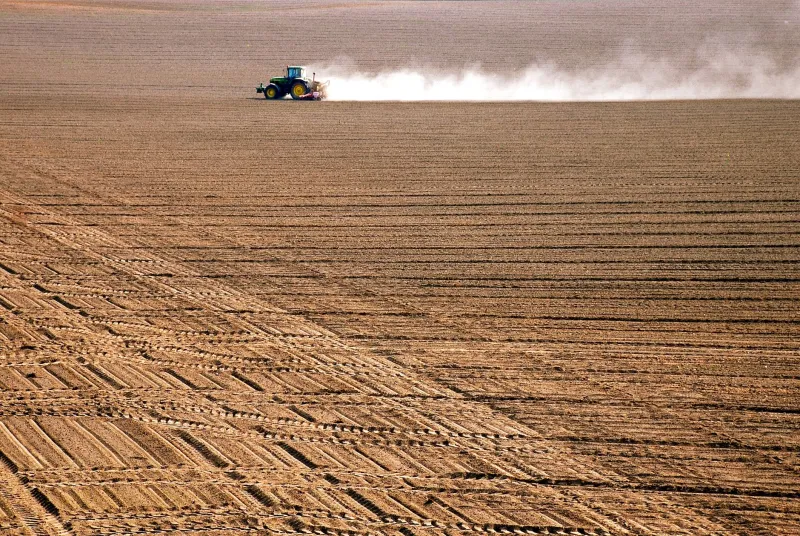
There's a slow-motion crisis happening under a lot of Wisconsin fields right now. It doesn't announce itself with a dramatic crop failure or a single bad season. Instead, it shows up as yields that plateau for no obvious reason, water pooling in spots that used to drain fine, and fuel costs that keep creeping up because your equipment is working harder than it should. What you're likely dealing with is compaction — and if you haven't been actively managing for it, there's a good chance it's worse than you think.
Compaction is one of those problems that's easy to underestimate because the damage happens incrementally. Each pass of a loaded grain cart, each wet-field tillage run, each spring planting push when the soil isn't quite ready — they all add a little more compression to a structure that took decades, sometimes centuries, to build. The frustrating part? The consequences often don't show up for a year or two, which makes it nearly impossible to connect cause and effect without actually digging in and looking.
What's Actually Happening Underground
Soil structure isn't just dirt packed together. Healthy soil is roughly 50% solid material and 50% pore space — a mix of air and water channels that roots use to breathe, drink, and push through. Soil organisms depend on that same architecture. When you compress soil, you're collapsing those pores. The particles get pushed together, the channels close up, and suddenly roots can't penetrate, water can't infiltrate, and the microbial communities that drive nutrient cycling are working in an oxygen-deprived environment that favors the wrong organisms.
There are two main zones where this plays out. Surface compaction — typically in the top six to eight inches — is largely caused by tire traffic and tillage equipment. This layer is bad enough, but it's actually the more manageable of the two. Subsoil compaction, which happens below tillage depth (usually eight to eighteen inches), is far more stubborn. It develops when heavy axle loads push stress deeper than your annual tillage ever reaches. Once it's there, it doesn't go away on its own. Not in a season, not in a decade.
University of Wisconsin-Madison extension research has documented compaction in Wisconsin soils across multiple soil types, from the heavier clay loams in the southwest to the sandier soils in central Wisconsin. The pattern is consistent: farms that have increased equipment weight over the past two decades without adjusting their management approach are showing measurable increases in bulk density — the technical measure of how tightly soil is packed. Higher bulk density means less pore space, slower water movement, and harder going for roots.
Timing Is Everything — and Most Farmers Know It, But...
Here's the uncomfortable truth: most farmers already know the biggest driver of compaction is field traffic on wet soils. The science on this is not ambiguous. Soil is dramatically more vulnerable to compaction when it's wet because water acts as a lubricant between particles, allowing them to slide and compress more easily. A single pass with a loaded combine on soil at or near field capacity can cause more structural damage than dozens of passes on dry ground.
The problem isn't knowledge — it's economics and weather. Harvest windows are tight. Planting deadlines feel real. Nobody wants to leave yield in the field or lose days to weather delays. These are legitimate pressures, not farmer negligence. But the data suggests that short-term convenience is costing a lot of operations more than they're saving. Research from Midwest land-grant universities has shown yield drag from compaction ranging from 10% to over 20% in severe cases, with the effects compounding over time.
So what do you actually do? A few things that go well beyond the usual advice:
Reduce axle load, not just tire pressure. Tire inflation adjustments help distribute weight over a larger footprint, but they don't reduce the total load stress moving through the soil profile. If subsoil compaction is your problem, the more meaningful intervention is reconsidering equipment sizing — or at minimum, restricting your heaviest equipment to established traffic lanes where the damage is already done and concentrated.
Use controlled traffic farming (CTF) principles. CTF means designating permanent wheel tracks and keeping all field operations on those same lanes, season after season. The idea is that you sacrifice a small percentage of your field to permanent compaction so the rest of it stays biologically and structurally healthy. Adoption in Wisconsin is still limited, but the yield and input efficiency data from operations that have implemented it is genuinely impressive.
Cover Crops That Actually Penetrate, Not Just Protect
The "add organic matter" advice isn't wrong — it's just incomplete. Organic matter improves aggregate stability and can help prevent future compaction, but it won't mechanically break up a dense subsoil layer that's already there.
That said, the right cover crop selection can do real biological work in the compaction zone. Tillage radishes get a lot of attention here, and for good reason — their taproots can push through moderately compacted layers and leave behind biopores that subsequent cash crop roots can follow. But they winter-kill, so the benefit is largely structural and temporary.
For more persistent impact, consider deep-rooted perennial species in rotation, or mixes that include hairy vetch and cereal rye, which together create both deep root channels and surface biomass that feeds the soil life responsible for aggregation. The key is matching your cover crop selection to your specific compaction depth — and knowing that covers work best as prevention and moderate remediation. They won't fix severe subsoil compaction on their own.
When Biological Approaches Aren't Enough
Let's be direct about something the sustainable ag community sometimes dances around: there are situations where biological approaches alone won't cut it, and pretending otherwise doesn't help anyone.
If you're dealing with a hardpan layer — a dense, nearly impermeable layer that formed from decades of tillage at the same depth — you likely need mechanical intervention first. Deep tillage tools like subsoilers or paraplow-style implements can fracture that layer and create the initial porosity that biological activity needs to take hold. The critical piece is timing: subsoiling on dry soil, when the fracture pattern is more shatter-and-crack than smear-and-compress. Wet-soil subsoiling can actually make compaction worse.
After mechanical remediation, the biological approach kicks in and becomes essential. Without following up with cover crops, reduced traffic, and organic matter additions, the layer will reform — often within three to five years. Mechanical intervention buys you a window. Biology is what keeps it open.
Reading Your Field Before You Act
Before spending money on any intervention, do a simple penetrometer test across your fields — multiple locations, multiple depths. A penetrometer measures resistance in pounds per square inch (PSI), and root growth begins to slow significantly above 200 PSI and largely stops above 300 PSI. This tells you whether you have a problem, where it is, and how severe it is. Dig a few soil pits while you're at it. Look at root architecture. Roots that grow horizontally when they should grow down are telling you something important.
Compaction isn't a failure — it's a feedback loop that most modern farming systems create almost inevitably. The farms that are getting ahead of it are the ones treating soil structure as a managed asset, not a static backdrop. That means integrating traffic planning into every field decision, choosing cover crops with mechanical purpose, and being honest about when the biology needs a head start from a machine.
Your soil has been working for you. It's worth working back for it.

