Your Soil Is a Sponge — Or It Isn't: How Organic Matter Runs Your Farm's Water Budget

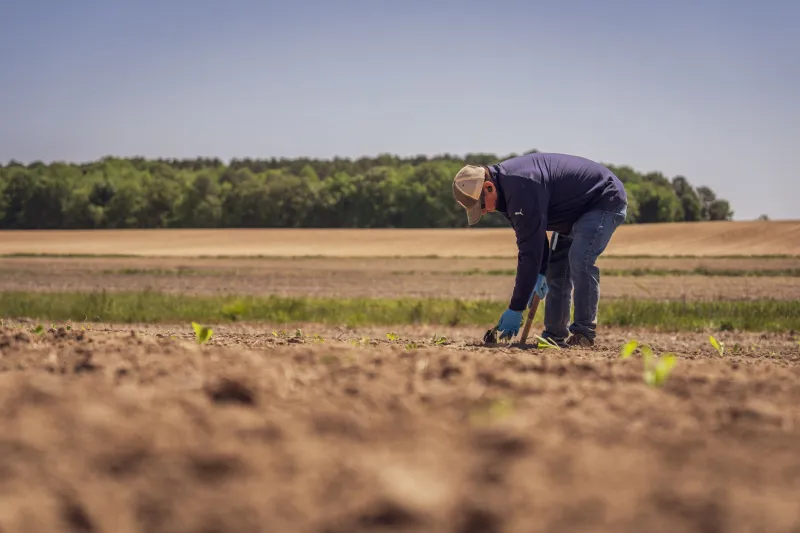
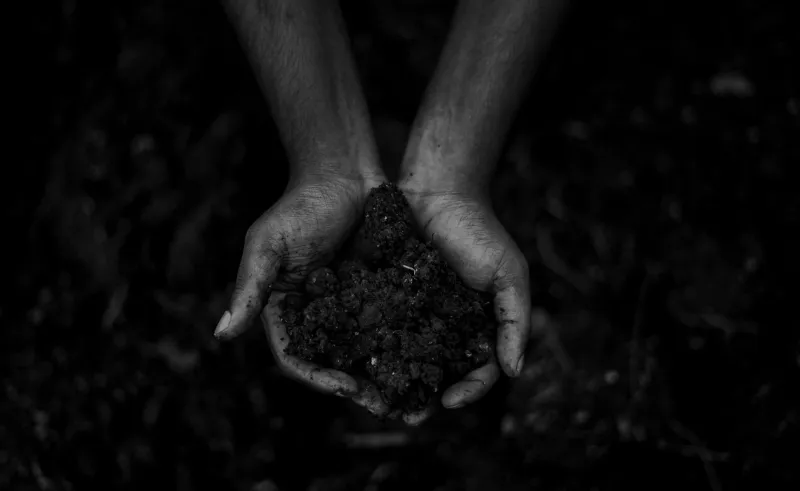
Photo: farmer examining healthy dark soil with water droplets infiltrating surface Wisconsin farmland, via fbi.cults3d.com
Talk to most Wisconsin farmers about water management, and the conversation goes straight to tile lines, contour berms, or whether it's worth investing in irrigation. Those are real tools with real value. But there's a quieter, cheaper, and frankly more powerful water manager already on your farm — and it's sitting right under your boots.
Soil organic matter (SOM) is the invisible accountant of your farm's water budget. It doesn't show up on a drainage map or a pump schedule, but it's making decisions about water infiltration, storage, and plant availability every single day. And if you're not thinking about it in those terms, you're probably leaving both yield and resilience on the table.
Two Fields, Same Clay, Completely Different Water
Here's something that trips up a lot of growers: two fields can have nearly identical soil texture — same percent sand, silt, and clay — and still behave like they're on different planets when it comes to water. One puddles after a half-inch rain. The other soaks it up and keeps producing through a dry stretch in August. The difference, more often than not, comes down to organic matter.
This isn't just a theory. Research out of the University of Wisconsin–Madison and USDA-ARS work done across the Upper Midwest consistently shows that SOM levels are among the strongest predictors of soil water-holding capacity, even when texture is held constant. In Wisconsin's diverse glacially-deposited soils — ranging from the heavy clays of the Lake Michigan lowlands to the sandy loams of the Central Sands — organic matter is often the variable that explains what texture alone cannot.
The reason goes deeper than "organic matter is fluffy and holds water." The actual mechanisms are more interesting than that.
The Structural Engineering Happening in Your Topsoil
Organic matter doesn't just sit in your soil — it builds architecture. When organic carbon compounds interact with mineral particles, they help form aggregates: clumps of soil particles held together by fungal hyphae, bacterial biofilms, plant root exudates, and humic substances. These aggregates create a pore structure that would make a civil engineer jealous.
Macropores — the larger spaces between aggregates — allow water to infiltrate quickly during rain events, reducing runoff and erosion. Micropores — the tiny spaces within aggregates — hold water tightly enough that it doesn't drain away, but loosely enough that plant roots can access it. A soil with well-developed aggregate structure is running both systems at once: fast infiltration and steady retention.
Destroy that aggregate structure through tillage, compaction, or organic matter depletion, and you lose both functions. Water either runs off the surface or drains straight through without being available when crops need it. You've essentially traded a sophisticated water management system for a leaky pipe.
The numbers tell a sobering story. Research suggests that each 1% increase in soil organic matter helps soil hold an additional 20,000 gallons of water per acre. For a Wisconsin farmer watching corn roll up its leaves in a July dry spell, that's not an abstraction — that's the difference between a stressed crop and one that keeps pushing through.
What This Means for Wisconsin Specifically
Wisconsin's climate makes this especially relevant. We don't get predictable, gentle rains distributed evenly across the growing season. We get intense spring deluges followed by dry windows, and increasingly volatile summer weather patterns that swing between heavy precipitation events and extended dry stretches. Soil that can buffer those extremes — absorbing excess water quickly and releasing it slowly — is an enormous asset.
In the Central Sands region, where sandy soils naturally drain fast and hold little water, organic matter becomes even more critical. Growers there who've committed to cover cropping, reduced tillage, and manure incorporation report measurable improvements in water retention that translate directly to reduced irrigation costs. Even modest SOM gains — moving from 1.2% to 2.0% organic matter — can shift the economics of irrigation meaningfully over a dry season.
In the heavier soils of southern Wisconsin's dairy country, the story flips slightly. Clay soils can hold plenty of water, but without good aggregate structure driven by organic matter, they hold it too tightly or become waterlogged. Here, SOM improves drainage and aeration, not by adding more pore space in absolute terms, but by organizing pore space so it actually functions.
Benchmarks Worth Knowing
So what are we actually aiming for? Wisconsin soils vary widely, so there's no single magic number, but here are some working benchmarks that soil scientists and extension agronomists use as reference points:
- Below 2% SOM: Serious concern. Water infiltration and retention are likely compromised. These soils are vulnerable to both drought stress and runoff events.
- 2–3.5% SOM: Functional but improvable. Most conventionally farmed Wisconsin cropland falls here. Water management is workable, but you're leaving capacity on the table.
- 3.5–5% SOM: This is where the water-holding benefits really start to compound. Soils in this range show measurably better infiltration rates and plant-available water.
- Above 5% SOM: Typically found in soils with long histories of perennial cover, manure applications, or reduced tillage. Water management is genuinely excellent at this level.
These aren't hard cutoffs — they're conversation starters for what your soil could be doing for you.
Building the Sponge: Practical Levers
The frustrating truth about SOM is that it builds slowly. You can't add organic matter the way you add fertilizer and see results next season. But the management levers are well-established:
Cover crops add living roots and above-ground biomass, feeding soil biology and contributing organic carbon. Species with deep taproots — radishes, turnips, cereal rye — also physically break up compaction layers that restrict water movement.
Reduced tillage protects the aggregate structure that SOM builds. Every time you run a tillage implement, you're breaking up aggregates and exposing organic carbon to oxidation. No-till and strip-till aren't magic bullets, but they stop the bleeding.
Manure and compost add organic carbon directly, and in Wisconsin's dairy-heavy landscape, this is an underutilized asset on many farms. Applied thoughtfully — not just as a disposal solution — manure is one of the fastest ways to move the SOM needle.
Perennial integration — whether that's grass waterways, contour strips, or integrating hay into rotations — builds SOM in specific areas and buffers water movement across the landscape.
Stop Managing Water Like It's 1985
The infrastructure model of water management — more tile, bigger pumps, deeper ditches — made sense when soil health wasn't part of the conversation. But we know more now. We know that a farm with 4% organic matter in its topsoil is running a water management system that no engineered drainage network can fully replicate.
That doesn't mean drainage infrastructure is obsolete. It means you're leaving serious money and resilience on the table if you're only thinking about water management in those terms.
Your soil wants to be a sponge. Give it the organic matter it needs to do that job, and it will repay you every time the sky opens up — or doesn't.