Wet Fields, Hard Choices: Rethinking Tile Drainage Before You Dig Another Trench
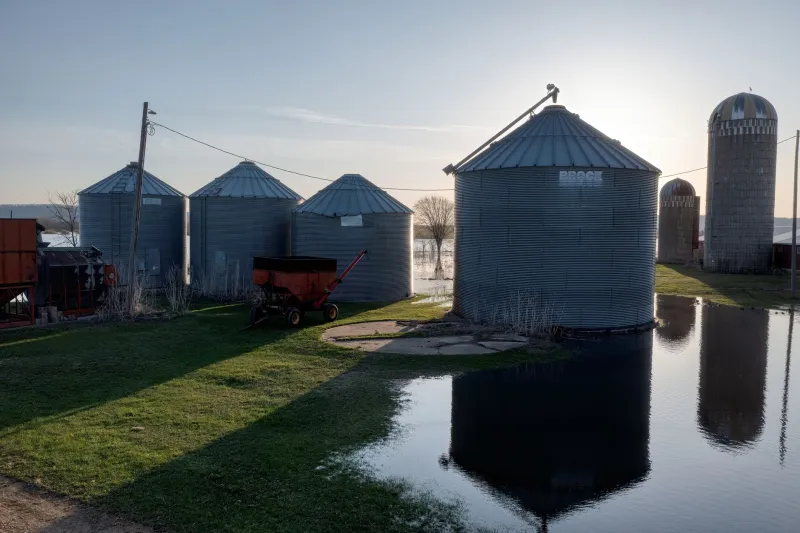
There's a particular kind of frustration that comes with standing at the edge of a soggy field in April, watching your planting window shrink by the day. Wisconsin farmers have been solving that problem the same way for generations: call the drainage contractor, lay more tile, move the water out. It's a solution so embedded in our agricultural culture that questioning it almost feels like agricultural heresy.
But here's the thing — the science is starting to ask us to slow down.
That doesn't mean tile drainage is bad. It means the story is more complicated than we've been telling it, and in a state where heavy clay soils, unpredictable precipitation, and increasing pressure on water quality are all colliding at once, complicated stories deserve a closer look.
How We Got Here: The Legacy of Draining Wisconsin
Artificial drainage transformed Wisconsin's agricultural landscape starting in the mid-1800s. Those dense glacial clay soils in the central and southwestern parts of the state — the ones that hold water like a bathtub — weren't farmable without serious intervention. Tile systems, first ceramic and later perforated plastic, became the engineering backbone of productive Wisconsin agriculture.
By some estimates, millions of acres across the upper Midwest are underlaid with drainage tile today. It's infrastructure as invisible and essential as the pipes under a city. And for decades, the calculus was simple: wet soil equals lost yield, so drain the wet soil.
What that calculus didn't fully account for was everything else living in that soil — and everything that happens to the water once it leaves your field.
What the Research Is Actually Saying
Recent work in soil science has reframed how we think about soil moisture, and it's not a comfortable reframe for anyone who's invested heavily in drainage infrastructure.
Soil water isn't just a problem to be managed. It's a medium. It's how nutrients move, how microbial communities communicate, how fungal networks transport carbon and phosphorus across root zones. When we drain aggressively and consistently, we're not just removing excess water — we're altering the entire biological environment underground.
Researchers at institutions like the University of Wisconsin-Madison have been documenting how drainage intensity affects microbial diversity. Highly drained soils tend to favor aerobic bacteria, which is fine for decomposition but can accelerate the loss of soil organic matter. That's the carbon you've been working to build. It oxidizes faster in drier, more aerated conditions.
There's also the nitrogen question. Tile drainage is a primary pathway for nitrate loss in Wisconsin. Water moving quickly through saturated soil and out through drainage lines carries dissolved nitrates straight toward our streams, rivers, and eventually the Great Lakes. It's a significant contributor to water quality issues that Wisconsin is actively trying to address — and it's coming, in part, from fields that are being drained faster than biology can process the nutrients.
The Climate Wrinkle
Here's where things get genuinely tricky for farmers trying to plan long-term.
Wisconsin's precipitation patterns are shifting. We're seeing more intense rainfall events — the kind that dump two or three inches in a few hours — interspersed with longer dry stretches. That's a fundamentally different challenge than the steady, seasonal wetness that traditional tile systems were designed to handle.
A drainage system engineered for consistent spring saturation may be poorly matched to a future where you need to retain moisture during a July dry spell just as urgently as you need to remove it in May. The infrastructure that saves your crop in a wet spring can leave you scrambling in a dry summer.
This is driving interest in what researchers and conservation engineers are calling "controlled drainage" or "drainage water management" — systems that allow farmers to adjust the outlet level of their tile lines seasonally, essentially using the drainage infrastructure as a water storage tool when conditions call for it.
So What Should You Actually Do?
This is the part where we resist the urge to give you a tidy answer, because honestly, there isn't one. What we can give you is a framework.
If you have aging tile that's failing, don't automatically replace it in kind. Use the replacement as an opportunity to assess whether the original drainage intensity still makes sense for your operation, your soil health goals, and your local water quality context. Talk to your county's Land and Water Conservation Department before you call the contractor.
If you're considering new tile installation, ask harder questions than your grandparents had to ask. What's the outlet situation? Where does this water go? Is this field genuinely unproductive without drainage, or is it marginal and might serve you better as a wetland buffer, a perennial forage area, or a carbon-sequestering prairie strip? The USDA's RCPP and EQIP programs have funding specifically for wetland restoration and alternative drainage approaches — money that might be worth more to your operation than another tiled field.
If you have functioning tile, consider retrofitting with water control structures. Controlled drainage is one of the most cost-effective practices available for reducing nutrient loss while maintaining yield potential. Wisconsin farmers who've adopted it report meaningful reductions in tile discharge volume and nitrate concentrations, with minimal yield penalty in most years.
Get a soil health baseline before you do anything. If you don't know what your soil biology looks like right now — its microbial activity, its organic matter trends, its aggregate stability — you're making drainage decisions without half the relevant information. A basic soil health panel from your extension service or a private lab costs far less than a drainage project and tells you a lot about whether your soil is functioning or struggling.
The Harder Conversation
There's a cultural dimension to this that we'd be doing you a disservice to ignore.
Drainage infrastructure represents decades of investment, family labor, and inherited decision-making. Suggesting that some of it might need to be reconsidered can feel like a criticism of the farmers who built it — and that's not the intent here. The tile that your grandfather laid was the right call given what he knew, what the climate was doing, and what the market demanded. That's not the same as saying it's the right call for the next forty years.
Sustainable agriculture asks us to hold two things at once: deep respect for the knowledge embedded in traditional farming practice, and genuine openness to what science is learning about the systems those practices affect. That's not a comfortable place to stand. But it's where honest, forward-looking farm management has to live.
Wisconsin soils have been shaped by glaciers, by prairie roots, by generations of farming. They're resilient, but they're also telling us things — through compaction, through runoff, through declining organic matter — that we need to hear.
Before you dig the next trench, take a minute to listen.
Soil Sisters WI connects Wisconsin farmers and conservation advocates with the science they need to make better decisions underground. Explore our resources at soilsisterswi.org.